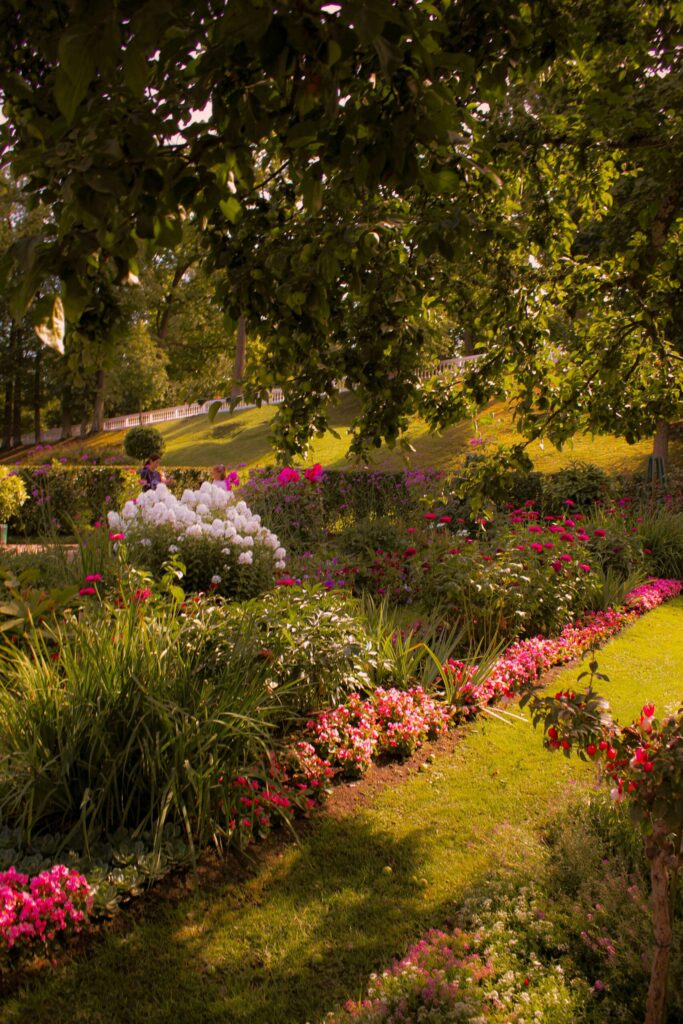
Summer has arrived and with it encompassing warm, bright and sunny days, a little cloudy in the afternoon and then cooling off at night from the cool breezes coming off the mountains. Its been more than a year since I’ve had the time to just sit and listen to the sounds and live into the colors of the day. Spring has come gracefully to an end, while summer begins almost without our knowing.
As I sit in the walled garden at the front of my home, I can hear the old railroad clock, in the dining space, ticking away with the occasional sound of the chimes calling me to the awareness of the hour and half hour. The city sounds of cars and ambulances fade away lost to chirping of the birds in the tall (40 feet) evergreens and Dutch Elms. A slight breeze wafts through like an expelled breath, saying quietly to me, as an vocal apparition of St. Julian of Norwich: “All will be well. All manner of things will be well. All shall be well.” Indeed, it already is. I can’t remember the last time I sat out listening to messages of the trees.
Skylark
Sings all day,
And day is not long enough.
—Basho. from Haiku—the Poetry of Zen, ed. Manuela Dunn Msacetti, Hyperion, p.33
The Summer Solstice happened on June 20 at 8:22 am, while I was walking home from my weekly visit to the Farmer’s Market, about eight blocks away. Within this momentous time we begin the sojourn around the sun to shorter and shorter days and longer nights. But we really won’t notice these changes well into August.
What summer does do? For all the lighthearted delight of summer garden fresh vegetables; fresh fruits off the trees; vacation madness or rest; sleepy afternoons; fresh sunny or misty mornings by seasides and lakesides; and, close quiet evening conversations under trees or on well-screened porches, summer has a will of her own. When the heat presses down and fields are full and trees bend and perfumed air floods the nights, we are subject to her intoxication which can, in many respects, make us go out of our heads. The late Zen teacher, Alan Watts said, “It is important that we go out of our heads at least once a day.” Maybe more often, I’ve added. We may even consider going out of our heads for the summer season.
What might that look like? Quite often we may follow our bodies. Is it sitting, or flying, swimming or dancing, jumping and running or walking slowly and intentionally somewhere for something. We often don’t know. Summer invites us to “go out of our minds” into the pleasurable sense of being embodied with no particular agenda at all, save perhaps, delighting in what is. I have found breathing slowly, becoming aware of breathing allows me to enjoy whichever vision is cast before my eyes. “And to what end,” you may ask? That indeed is the question that possesses all of us.
What would this kind of waiting look like for any one of us? Well, maybe resting our souls for a bit is needful at first. As a people and even as citizens of the world, America to the rest of the planet looks like something few of us could have imagined. Our world is in chaos as many democracies find themselves re-trenching to a more frugal, punitive, retaliatory, and less participatory or less-inclusive approach to political power and decision-making.
Catholic workers Movement founder, Dorothy Day once observed, “Our problems stem from our acceptance of this filthy, rotten system.” She was not talking about just one government or church or a particular time. She was pointing out a pattern, rather describing how systems that exploit and exclude become so familiar that people stop fighting them. That is the real danger in times like these.
It is not merely that leaders act recklessly or cruelly. The bigger risk is that the rest of us start to adjust. We begin explaining it away and gradually going along with it. We tell ourselves “this is just how things are right now.” Well, it should not be surprising about where I am with these things.
But back to losing our minds. Along this way I thought of a poem by Rainer Maria Rilke, about future:
You are the future,
the red sky before sunrise
over the fields of time.
You are the cock’s crow when night is done,
You are the dew and the bells of matins,
maiden, stranger, mother, death.
You create yourself in ever-changing shapes
that rise from the stuff of our days—
unsung, unmoored, un-described,
like a forest we never knew.
You are the deep innerness of all things,
the last word that can never be spoken.
To each of us you reveal yourself differently:
to the ship as coastline, to the shore as a ship.
—"You are the Future” in The Souls Is Here For Its Own Joy, ed. Robert Bly, Ecco Press, 1995.
Meantime, its still Summer and its time to “grout of our minds” for a bit.
Until next time,
Peace Always
Ted+
